
Who authorized the takeover? A case study by Merit Service Advocates.
Key findings
More than eighteen months after DOGE arrived, GAO could not determine the appointment type of more than 150 of the 206 DOGE personnel it identified, because agencies did not provide the information.
The official who signed the reduction-in-force notices to USAID’s remaining staff had not completed onboarding, and the agency’s own HR office did not see his delegation papers until a month later.
Courts have held that officials running Voice of America, the Institute of Peace, and the Inter-American Foundation were not lawfully in office, and in some cases declared their actions void.
OPM, the agency responsible for safeguarding the merit system, was found by two federal courts to have broken the law: once by directing other agencies’ firings, and once by opening its personnel records.
USAID did not report its vacant Administrator post to GAO for fourteen months. Interior reported its vacancies the day after the inauguration.
I. Day One, the way it is supposed to work
For most of my career, the weeks after a presidential election followed a familiar rhythm. I spent nearly a decade at the U.S. Office of Personnel Management (OPM) and sixteen years on the Chief Human Capital Officers Council, and I served as a Chief Human Capital Officer through presidential transitions at more than one agency. Career staff built briefing books for the incoming landing team. We briefed Acting Secretaries, new Secretaries, and their political teams on which offices were vacant, who could lawfully act in each, and which authorities could be delegated. We worked with the White House Presidential Personnel Office to confirm that each appointee was coming in under the correct authority. We cleared ethics requirements with counsel and the designated agency ethics official. We administered the oaths, completed the onboarding, and filed the vacancy and acting-official reports the law requires agencies to send to the Government Accountability Office (GAO) and Congress.
None of it was glamorous, and none of it was partisan. My teams ran the same process for every incoming administration, whichever party had won. New administrations arrived with ambitious agendas, and some moved fast. But the sequence held, because it is what makes everything an appointee does afterward legally defensible. By the time a new official signed anything, the agency could say who that person was, what position they held, and on whose authority they acted.
In 2025, that sequence was skipped, compressed, or run in reverse.
In August 2026, GAO reported that it had identified 206 people who met its definition of DOGE personnel and held positions within the Executive Office of the President through January 2026. For more than 150 of them, GAO could not determine their appointment type or whether they served as special government employees, because the agencies involved did not provide the information (GAO-26-108403). GAO did not assess whether DOGE’s hiring complied with the law, and its finding is not proof that anyone was unlawfully appointed. It shows something more basic: more than eighteen months after DOGE arrived, Congress’s own auditor could not document the legal footing on which most of these people had served.
That gap is not a paperwork footnote. In the first weeks of 2025, people working under DOGE’s banner directed, or were reported to have directed, some of the most consequential personnel actions in modern federal history. At USAID, the official who signed the reduction-in-force notices sent to the agency’s remaining staff on March 28, 2025 had, according to internal agency emails, not accepted his job offer or completed the federal pre-employment form as of March 26 (Wired, Oct. 27, 2026).
None of this turns on whether an administration may reshape the federal workforce. It may. Elections have consequences, and a new President is entitled to install leadership, set priorities, and pursue reorganization within the law. The question here is narrower and older than any policy dispute: did the people who issued these orders hold the authority the law requires of anyone who issues them? Put more plainly: who authorized the takeover?
This case study sets out how appointees normally come on board, when a defect can undo an action, what happened at USAID and four other agencies, and what reforms would make authority verifiable before power is exercised, not years afterward.
A note on method. This case study documents gaps in the contemporaneous record. A missing personnel record, a late vacancy report, or an unverifiable title is evidence that ordinary safeguards failed; it is not, by itself, proof that an appointment was invalid. Where courts have ruled, I report what they held. Where they have not, I say what remains open.
Disclosure: Merit Service Advocates has provided pro bono guidance to the American Foreign Service Association and has presented webinars for State and USAID employees affected by the actions discussed here.
II. How appointees normally come on board
The onboarding sequence is not a bureaucratic ritual. Each step answers a legal question that someone, whether an employee, an inspector general, or a judge, may later ask about an official’s action. In an ordinary transition, it runs like this:
Before Inauguration Day, career staff brief the incoming landing team on which offices are vacant, who may lawfully act in each, and which authorities are delegable.
For each appointee, HR confirms the appointment authority with the White House Presidential Personnel Office before the person starts.
The ethics office reviews financial disclosures and conflicts and, for special government employees, documents that status.
The oath is administered, and the appointment affidavit is executed by an authorized official.
Onboarding and vetting are completed before a badge is issued or a system account is opened.
For each vacant Senate-confirmed office, counsel identifies who may lawfully act and makes sure the required reports go to GAO and Congress.
Delegation orders are written, naming the delegate, the functions, and the source of authority, and are served on HR and security so those offices can honor them.
Behind that sequence is a distinction federal law draws sharply: between people who may advise the government and officials legally empowered to bind it. The categories run roughly from least to most authority.
Outside advisers. A private person, however influential, cannot direct a federal employee or commit federal resources. DOGE began in this category. When it was announced in November 2024, it was to “provide advice and guidance from outside of government” (Reuters via KSL), the kind of body the Federal Advisory Committee Act governs, with its requirements for a charter, balanced membership, and open records. Lawsuits filed on Inauguration Day pressed that point (Clearinghouse), but by then DOGE had been placed inside the Executive Office of the President, where advisers can become officials. Much of this case study is about that move from advice to authority.
Special government employees (SGEs). An SGE serves temporarily, no more than 130 days of service, consecutive or not, in any period of 365 consecutive days (18 U.S.C. §202(a)). The status is principally an ethics classification, not a grant of power; an SGE’s authority depends on the position lawfully assigned.
Detailees. A detail temporarily assigns an employee to different duties, most often within the employee’s own agency but sometimes at another. The cases here involve details between agencies. Either way, the detail instrument and its conditions, such as security screening, determine what the detailee may do and sometimes whether the detail has begun at all.
Federal employees and officers. An employee is someone appointed by an authorized official, performing a federal function, under federal supervision (5 U.S.C. §2105). An officer of the United States exercises continuing authority under federal law and must be appointed as the Constitution’s Appointments Clause requires: principal officers with Senate confirmation, inferior officers by the President, the courts, or department heads as Congress provides (Lucia v. SEC).
Acting officials. When a Senate-confirmed office is vacant, the Federal Vacancies Reform Act (FVRA) generally governs who may fill it temporarily: the office’s first assistant, a Senate-confirmed officer the President designates, or a qualifying senior agency employee the President designates (5 U.S.C. §3345). Service is time-limited, and agencies must report vacancies and acting designations to GAO and Congress (§3349).
Officials exercising delegated authority. Agency heads may delegate many functions, but not as a way to fill a vacant Senate-confirmed office by another name. A sweeping delegation can amount to an acting appointment in substance, and its legal effect must be assessed function by function (5 U.S.C. §3348).
The practical lesson is that status, position, and power are three separate questions. A person can be a lawful employee and still lack authority for a particular act. A person can hold a powerful title and still not be lawfully in office. Agencies keep those questions straight with a paper trail, created in the right order, that shows who someone is, what they may do, and on whose authority.
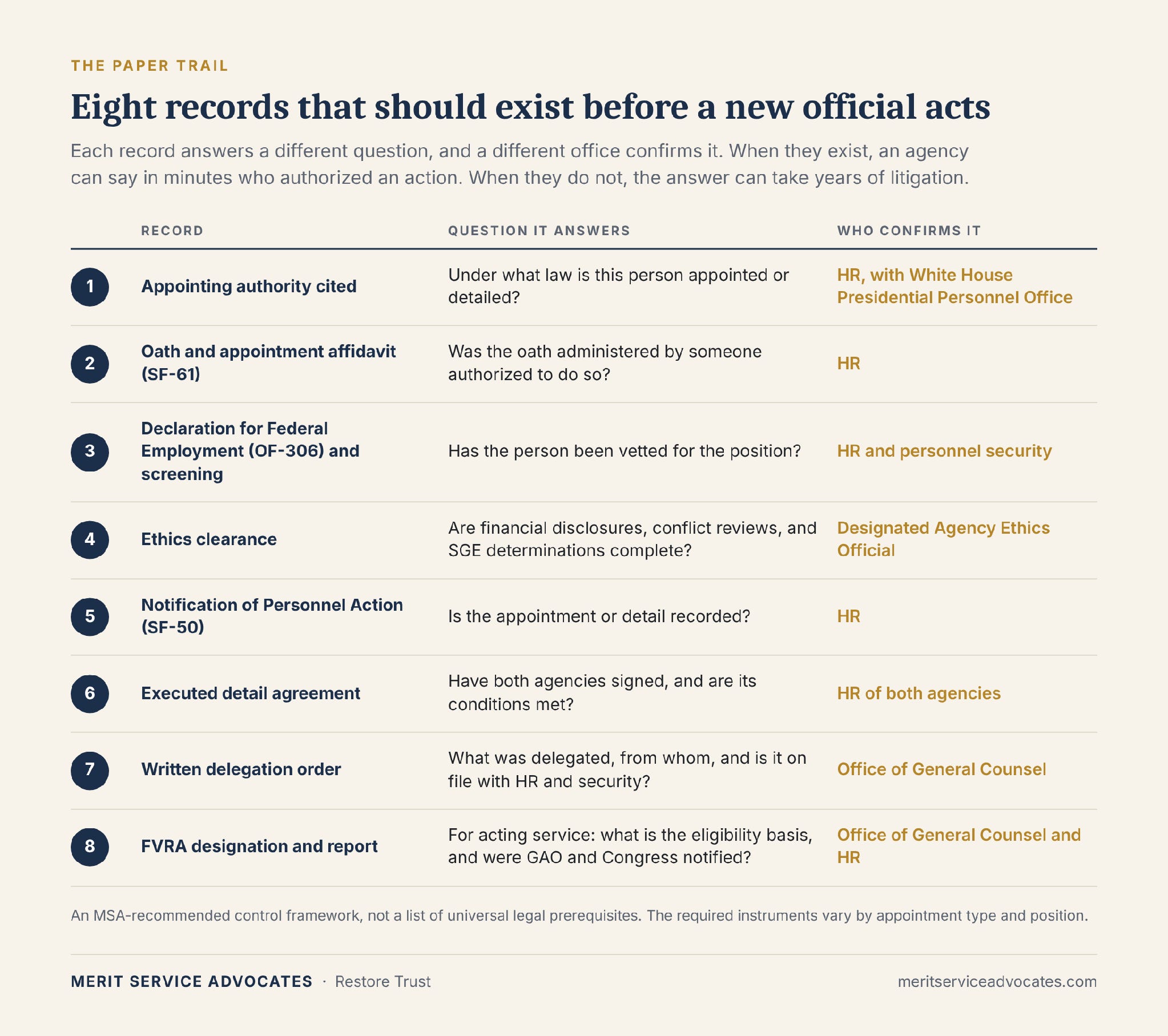
The paper trail: eight records that should exist before a new official acts, and who confirms each. An MSA-recommended control framework.
III. When does a defect invalidate a decision?
A missing record does not automatically void a personnel action. Whether a defect matters depends on three questions: Was the person lawfully appointed or otherwise authorized to serve? Was the action within the authority of that position or validly delegated? If not, what remedy does the law provide?
The Vacancies Act’s built-in remedy. The FVRA is unusual because Congress wrote the consequence into the statute. An action taken by someone not lawfully serving under the Act, in performing a function that statute or regulation reserves to a vacant office, has no force or effect and may not be ratified later (5 U.S.C. §3348(d)). The remedy is narrow: it reaches only those exclusive functions, not every act of someone whose authority is disputed. In the Voice of America litigation, a court applied it to void an acting chief executive’s actions over four months, including a reduction in force (Widakuswara v. Lake).
The Appointments Clause. A timely challenge to an officer’s appointment can entitle a litigant to relief, such as a new decision by a properly appointed official (Lucia v. SEC). The government’s usual defense, the de facto officer doctrine, does not defeat a challenge raised in time (Ryder v. United States). Outside the FVRA, a properly appointed official can sometimes ratify a defective action after the fact.
Two kinds of defect. In some cases the action might have been lawful, but the person who took it lacked authority, as at Voice of America and the Inter-American Foundation. In others, the action had no lawful basis no matter who signed it: a federal court found that OPM had no power to direct other agencies to fire their probationary employees (AFGE v. OPM).
Remedies remain unsettled. Some rulings have voided actions outright. Others found violations but limited relief, or were stayed on appeal, vacated for lack of standing, or dismissed as moot once the people involved had left. This case study does not predict how those cases end. Its subject is the step that comes before any remedy: whether the people acting could show, on paper and at the time, that they had the authority to act.
IV. The USAID test case
USAID is the clearest illustration of how hard it can be to answer a simple question: under what authority did the person who dismantled the agency act? The record shows at least three possible answers, each with a different weakness, and an onboarding file that was still incomplete when the most consequential orders were signed.
The chronology
January 27, 2025. Dozens of senior USAID officials are placed on administrative leave, the same day DOGE first arrives at the agency. Who ordered it remains disputed.
January 28. Jeremy Lewin, a DOGE affiliate, later stated in a sworn declaration that he began at USAID that day as a senior adviser.
February 3. Secretary of State Marco Rubio becomes acting USAID Administrator (GAO vacancy record).
February 4–21. USAID moves to place nearly all of its direct-hire workforce on administrative leave. A federal judge temporarily blocked the move on February 7 but declined to extend that relief on February 21.
February 14. A GSA–USAID detail agreement for Lewin is dated. It makes the detail contingent on his security adjudication and pre-employment screening.
Before March 18. A team including Lewin issues orders, among them directions to lock staff out of agency systems.
March 18. A federal court bars the government from taking “any other actions relating to USAID without the express authorization of a USAID official with legal authority to take or approve the action.” The same day, Rubio delegates the authority of the Deputy Administrator for Policy and Programming and Chief Operating Officer to Lewin, designates him an “officer of the United States,” and signs an unpaid appointment citing 22 U.S.C. §2385(b).
March 20–26. The White House liaison asks HR to onboard Lewin and supplies March 18 as a retroactive start date. By March 26 he has not accepted the offer or filed the pre-employment form.
March 27-28. Lewin signs reduction-in-force notices to USAID’s remaining staff, dated March 27 and sent March 28. Later on March 28, the Fourth Circuit stays the injunction, noting that USAID officials, including Lewin as chief operating officer, had approved or ratified the reductions in force.
Late April. USAID’s HR office first sees the delegation documents.
Unless otherwise noted, the chronology comes from internal USAID emails and documents reported by Wired. Lewin told Wired he was a regular government employee with a valid State Department clearance throughout, that he was “detailed and dual appointed” on the advice of State Department and White House counsel, and that HR’s confusion lasted only days. The government filed the March 18 appointment document and a Lewin declaration in the Maryland litigation (ECF No. 77).
Three possible sources of authority
The GSA detail. The detail agreement made its start contingent on screening that, by HR’s account, was still incomplete at the end of March. If those conditions were unmet, it is an open question whether the detail had begun at all before March 18.
A State Department appointment. Lewin’s own account rests on a dual appointment. But a State Department position carries State Department authority. Directing USAID’s personnel requires USAID authority, and the documents showing how one conferred the other have not been made public.
The March 18 USAID appointment. This is the government’s strongest basis. Section 625(b) of the Foreign Assistance Act (22 U.S.C. §2385(b)) allows up to 110 U.S.-based positions to be filled “without regard to the provisions of any law” to carry out functions under the Act. A former senior USAID official told Wired the authority had traditionally been used to deploy emergency-response staff quickly, including to disaster zones abroad. That is an account of past practice, not a limit written into subsection (b).
Congress has since drawn its own line. In December 2024, it added subsection (k), a separate authority to hire excepted-service personnel to prevent or respond to foreign crises, with its own funding and oversight requirements. Lewin’s appointment cited subsection (b), not (k). So the question is not whether subsection (b) permits hiring outside ordinary civil-service rules; it plainly does. It is whether this position met the statute’s requirements, including its connection to the Act’s foreign assistance functions. Using an authority meant to carry out foreign assistance to install the official who would oversee dismantling it raises a substantial question of statutory purpose, even if, as one law professor told Wired, the appointment appears technically lawful.
A second set of questions goes to whether the appointment was validly made at all: whether Secretary Rubio, as acting Administrator, held the power to make it under Executive Order 12163; whether a §2385(b) position was available; and, because Rubio designated Lewin an “officer of the United States,” whether the appointment satisfied the Appointments Clause.
The delegation question
Even a lawful appointment answers only half the question. Lewin’s power to close missions and separate staff came from Rubio’s delegation of a vacant Senate-confirmed post, the Deputy Administrator for Policy and Programming (2024 Plum Book). The delegation also reached further. Under USAID’s organizational directive, the Chief Operating Officer role belongs to a different Senate-confirmed post, the Deputy Administrator for Management and Resources, whose portfolio includes the agency’s human capital office, according to the Partnership for Public Service’s description of the position. If that directive was in effect in March 2025, the delegation conveyed authority from two Senate-confirmed offices, including the one responsible for personnel, to a single official who held neither.
Rubio’s own acting service was lawful on its face; as a Senate-confirmed Secretary, he was eligible under the FVRA and served within its time limits. But if the functions Lewin exercised were reserved exclusively to those vacant offices, delegating them to someone outside the Act’s categories would leave the resulting actions with no force or effect. If the functions were delegable, the delegation stands. That is the line the Voice of America court drew when it held that sweeping delegations had made an official the agency’s chief executive “in all but name.” Whether USAID crossed it depends on records not yet public.
What the record shows, and what it does not
USAID’s security office could not issue Lewin an agency ID because its database had no employee record for him, and HR did not see the delegation documents until late April. In the agencies where I served, the credential was the last step of onboarding, not the first: security issued a badge only after HR had recorded the appointment. A badge office with no record is a sign that the ordinary sequence never ran. That does not, by itself, prove that no valid appointment existed elsewhere. GAO’s vacancy database also shows, as of October 29, 2026, that USAID first reported the Administrator vacancy on April 9, 2026, more than fourteen months after it began and well after the agency’s closure (GAO vacancy record).
The public record does not establish that Lewin lacked authority. The sufficiency of his appointment, the scope of Rubio’s delegation, and the reach of the FVRA remain largely untested. The class challenging the agency’s dismantling has been certified (Hall Benefits Law), and in March 2026 the Fourth Circuit blocked depositions of Lewin and others (Law360). The open question is itself the finding: the agency’s employees, its HR office, and the courts have spent the better part of two years trying to learn who held authority over it.
V. Beyond USAID
USAID was not the only agency where the record raised questions about the status, access, or authority of DOGE-connected personnel. Each case below illustrates a different issue. Together they do not establish a single defect common to every agency, but they show a pattern.
Voice of America: authority by delegation
Kari Lake joined the U.S. Agency for Global Media as a senior adviser in early 2025. The acting CEO delegated nearly all of his functions to her, and from July 31 she claimed the acting CEO role herself (Bloomberg Law). In March 2026, Judge Royce Lamberth held that her service, formally or in substance, violated both the Appointments Clause and the FVRA, finding that the delegations had made her CEO “in all but name.” He declared her actions from July 31 to November 19, 2025 void, including an August 29 reduction in force (Clearinghouse). The government has appealed, and proceedings continue (Global Freedom of Expression).
GAO’s vacancy database shows that the agency first reported the CEO vacancy on November 19, 2025, ten months after it began and the day after Lake’s acting tenure ended (GAO vacancy record).
OPM: the safeguard becomes the mechanism
OPM is the agency charged with keeping the federal personnel system lawful. In early 2025 it became the source of two adjudicated violations.
Day one. Reuters reported, citing two agency officials, that a team including current and former Musk employees assumed command of OPM on Inauguration Day and that senior career employees lost access to key personnel data systems (Reuters via The Citizen). That same day, OPM directed every agency to send it a list of all probationary employees within four days. The new team’s own onboarding, by contrast, ran on schedule: a senior adviser testified that career OPM leadership was on hand, and that he and other appointees signed their appointment papers with an HR officer that morning (Peters Dep. 11–12). OPM’s process for bringing in its own people worked on Day One. What followed shows what happens when the same care is not applied to the authority those people exercised over every other agency.
Directing the firings. The senior adviser who drafted the January 20 memo testified that he began writing it on his own before joining the government (Peters Dep. 24–26). He testified that agencies asked OPM for permission to keep their probationary employees, and that OPM granted those “exemption” requests, including for the EEOC, the Department of Justice, and FAA air traffic controllers (id. at 87–88). On February 14, he read the Chief Human Capital Officers Council a script matching OPM’s instruction that day to separate probationary employees not identified as mission-critical by the end of February 17 (id. at 64, 169; AFGE v. OPM). Judge William Alsup later found that OPM decided who would be fired and when, and that it had exceeded its powers (Federal News Network). The Supreme Court had earlier stayed his reinstatement order on standing grounds, not because OPM acted lawfully (CRS).
Opening the records. In October 2026, Judge Denise Cote held that OPM violated the Privacy Act by giving DOGE personnel broad access to records on tens of millions of current, former, and prospective federal employees. About 20 people received administrator-level permissions without required privacy training (Federal News Network). The court attributed the violations not to missing rules but to individuals who failed to honor safeguards already in place. Remedies are pending.
The Institute of Peace and the Inter-American Foundation: invalid acting heads
At the U.S. Institute of Peace, Judge Beryl Howell declared the appointments of DOGE-affiliated acting presidents invalid and their actions void (CBS News). The D.C. Circuit stayed her ruling on the separate question of the President’s removal power, and the appeal is pending (The Hill).
The Inter-American Foundation presents the appointment question more cleanly. After the President removed the foundation’s board, he designated Pete Marocco as an acting board member, and Marocco voted himself acting president. Two judges on a D.C. Circuit panel, in a concurring statement, reasoned that the board’s members are principal officers requiring Senate confirmation (D.C. Cir. order), and the district court’s final judgment declared that the FVRA does not permit acting board members (judgment).
The data systems: access before vetting
At the Social Security Administration, a federal court found that DOGE staff received access to agency systems before their background checks were complete or their detail agreements were final (NPR). Those findings did not produce lasting relief: the Supreme Court allowed SSA access while the case proceeded, and the full Fourth Circuit later vacated the injunction (Law360). A parallel Treasury case was dismissed as moot after the DOGE team there disbanded (Fox News). But the risk did not end there. In March 2026, a whistleblower alleged that a former DOGE engineer at SSA had kept copies of sensitive agency databases and told colleagues he wanted to share the data with his new private-sector employer. SSA’s inspector general is reviewing the complaint; SSA said the former employee and the company deny the allegations, and no findings have been made (NPR). Access first, vetting later.
The pattern
GAO’s work confirms the documentation gap from the outside, though not any legal conclusion. Beyond the missing appointment types, it found missing or incomplete ethics training and financial disclosure records, and USAID provided no information at all (NOTUS).
The contrast with ordinary practice is visible in GAO’s vacancy database: the Department of the Interior reported vacancies in nine Senate-confirmed offices on January 21, 2025, the day after the inauguration (GAO vacancy search). From 2015 to 2022, through two presidential transitions, my office prepared Interior’s vacancy and acting-official reports and I signed them on the department’s behalf. I had left Interior in early 2022; the January 2025 reports were filed by the career staff who followed. That is the point: done right, the process does not depend on any one person.
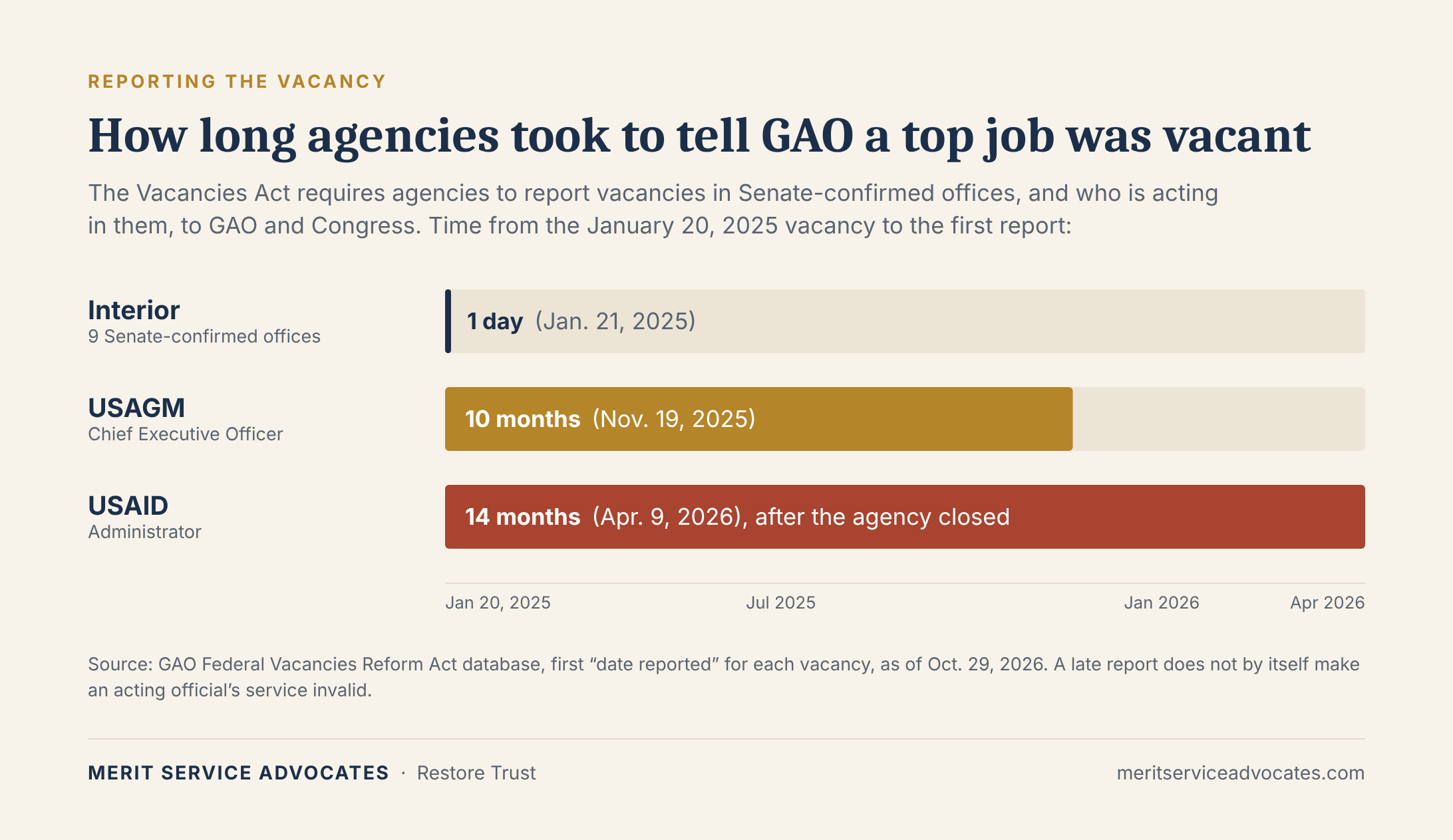
How long agencies took to report a vacant top job to GAO: Interior, 1 day; USAGM, 10 months; USAID, 14 months. Source: GAO Federal Vacancies Reform Act database.
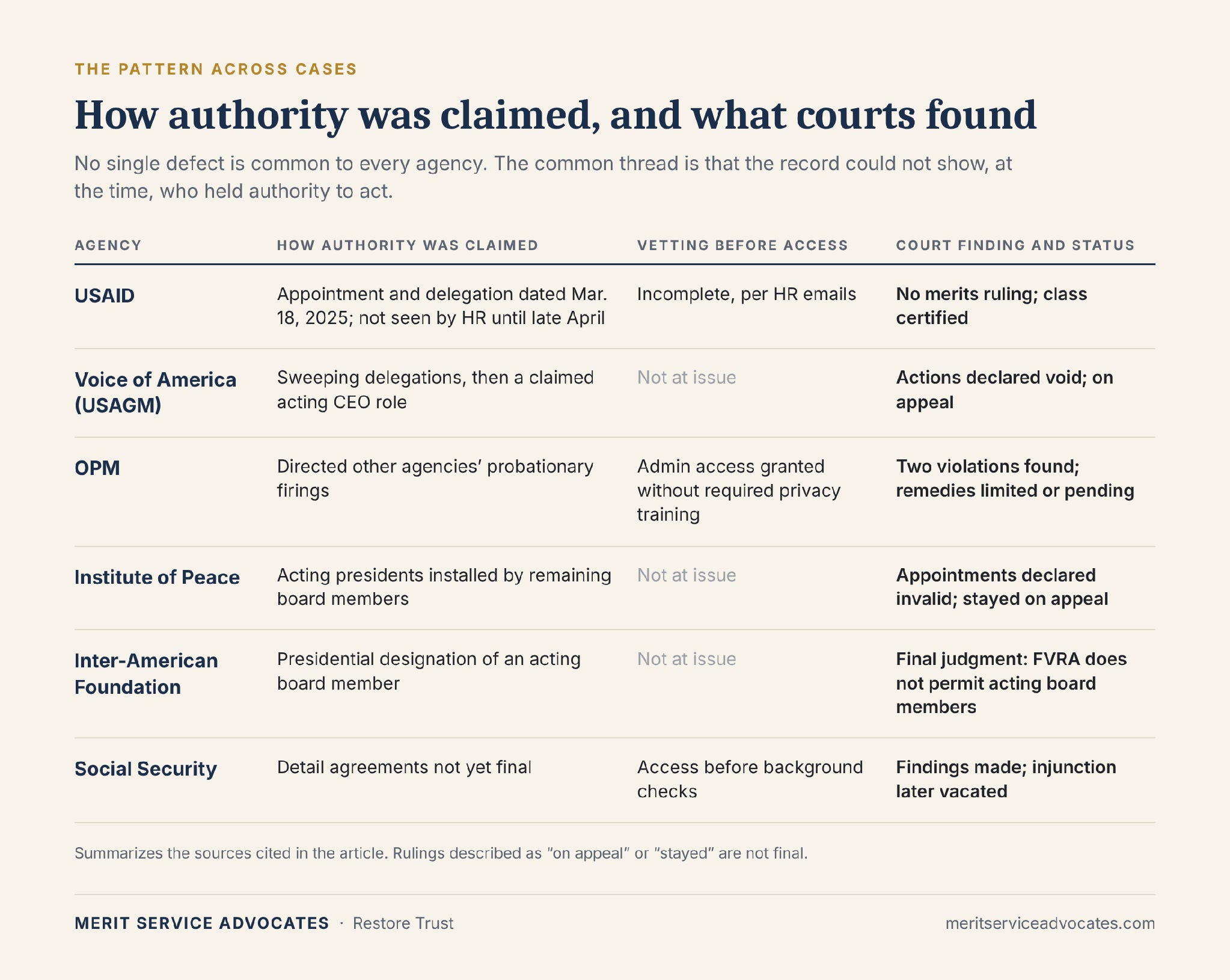
The pattern across cases: how authority was claimed at six agencies, whether vetting preceded access, and what courts found.
VI. What the safeguards protect
Nothing in the onboarding sequence prevents a new administration from acting promptly. Interior filed its reports the day after the inauguration. A documented chain of authority is not a brake on change; it is what allows change to survive a court challenge.
I have run that sequence for Acting Secretaries, new Secretaries, and their teams. It is rarely noticed when it goes right. Its value lies in what it makes possible afterward: anyone, from an employee to a judge, can ask who authorized an action and get an answer from the record.
I have long described workplace accountability as a three-legged stool: the supervisor who acts, the HR and labor and employee relations staff who confirm the action is procedurally sound, and counsel who confirms it is legally sound. Remove a leg and the stool does not stand. The cases in this study show what happens when all three are compromised at once. People of uncertain status took the supervisor’s place. HR offices were bypassed or, at OPM, locked out of their own systems. And where legal advice existed, it ran outside the agency’s own counsel and records, so the offices responsible for verifying authority could not see it.
OPM’s role deserves particular attention, because OPM is supposed to keep every other agency’s stool upright. The Chief Human Capital Officers Council, on which I served for sixteen years, exists so OPM and agency HR leaders can work through government-wide personnel actions together. In early February 2025, the council met with OPM every day. OPM’s senior adviser described those sessions as a dialogue in which CHCOs asked questions and offered input (Peters Dep. 63–64). But on February 14, he testified, he read the council a script matching OPM’s instruction to separate non-mission-critical probationary employees within three days. On that day, at least, the forum built for deliberation became a channel for direction. A court later found that the direction itself was beyond OPM’s legal power.
The lesson does not belong to one party or one administration. Every future transition will feel the same pressure to move fast and show results. The safeguards exist precisely for that moment, because the people most eager to act on day one are the ones whose authority most needs to be established first.
VII. Recommendations for reform
Each recommendation below would apply equally to any administration. Several go beyond current law; they are MSA reform proposals, not descriptions of existing legal duties.
Certify authority before it is exercised. No one acting in a delegated or acting capacity should sign a personnel action, terminate a contract, or grant systems access until the agency’s HR office and general counsel certify that the paper trail is complete. Delegation orders for Senate-confirmed functions should be published. The Administrative Conference of the United States recommended much of this in 2019 (ACUS Recommendation 2019-7). It is still voluntary. It should not be.
Give the Vacancies Act’s reporting requirement a deadline that bites. A fixed deadline, and a public GAO list of late or missing reports, would make a ten- or fourteen-month gap visible while it is happening. GAO identified reporting delays more than two decades ago (GAO-03-806), and the Partnership for Public Service has called on Congress to update the Act (Center for Presidential Transition).
Tie access to vetting, and make access auditable. Access to systems containing personal information should follow, never precede, completed background checks, ethics clearance, and training. Access logs should be available to inspectors general and GAO on request.
Protect OPM’s oversight role from its own leadership. OPM needs an oversight function that political leadership cannot bypass or lock out, and its guidance to agencies should be advisory unless a statute grants it direction authority. A court has already found that OPM had no power to order other agencies’ terminations; Congress can make that line explicit. In the interest of disclosure, I have separately proposed revamping OPM, as part of my Restore Trust campaign, to align its purpose with serving as the front door to national service.
Require transparency about nontraditional actors. Agencies should report to Congress, regularly, every special government employee and detailee exercising significant responsibilities, with each person’s appointment type. GAO should not have to ask, and agencies should not be able to decline.
Provide fast, independent review of high-impact personnel actions. When thousands of employees are affected at once, review that arrives years later protects no one. An independent forum able to examine mass actions quickly would give the paper trail a purpose.
Who authorized the takeover?
This case study began with a question: who authorized the takeover? For many of the people who issued these orders, the honest answer is still that no one can say.
The question reaches the top of the effort. The President publicly described Elon Musk as leading DOGE. In a sworn court filing, the White House said Musk was not a DOGE employee and had no formal authority to make government decisions (Fox News). Those statements address different things, political leadership, employment status, and legal authority, and they are not necessarily contradictory. But they leave the operative question unanswered. The White House named an acting DOGE administrator only after weeks of questions (CBS News), and she swore that the agency DOGE teams did not report to her. A federal judge found that Musk appeared to be functionally in charge even after she was named (Politico via Yahoo).
Meanwhile, the system Congress built to find fraud, waste, and abuse was weakened first. Seventeen inspectors general were removed in January 2025. A federal judge later found the removals violated the Inspector General Act’s notice requirements, but declined to reinstate them (CBS News).
So who authorized the takeover? Further investigation and greater transparency will eventually supply the answer. History usually does. But for the employees separated, the programs closed, and the records opened in those first months, the answer may arrive too late to matter. We need to keep those receipts. The purpose of the paper trail is to make sure that, next time, the answer exists before anyone acts.
An independent, merit-based civil service isn’t abstract. It’s not a perk. It’s a safeguard for every American.
Ray Limon is the founder of Merit Service Advocates. He served nearly a decade at the Office of Personnel Management and sixteen years on the Chief Human Capital Officers Council, as Chief Human Capital Officer at the Department of the Interior and the Corporation for National and Community Service and as Deputy CHCO at the Department of State, leading presidential transition work at more than one agency. He later served as Vice Chairman and Acting Chairman of the U.S. Merit Systems Protection Board. Learn more at MSA Webpage